MyPlate Worksheets in 2026: What Changed, Plus a Free Meal-Assembly Worksheet
MyPlate worksheets explained: MyPlate was the federal food icon from 2011 to 2026. Print a free adult meal-assembly worksheet based on the 2025–2030 guidelines.
MyPlate worksheets are printable sheets built around MyPlate, which was the visual icon for the Dietary Guidelines for Americans from 2011 to 2026. In 2026 the Dietary Guidelines for Americans, 2025–2030 were published with a new visual icon. [1] The current edition names six food groups: protein foods, dairy, vegetables, fruits, healthy fats and whole grains. [2] Some were written for families rather than for adults planning their own meals: USDA Team Nutrition’s MyPlate at Home, for example, is for parents of school-age children. [5] The free meal-assembly worksheet below is for adults: you build one meal at a time, food group by food group, using the current groups, and it has no calorie or serving targets.
This page is general education for adults, not individual nutrition advice. The worksheet does not set a calorie, serving or nutrient target; the guidelines note that the calories you need depend on your age, sex, height, weight and level of physical activity. [2] If you have a chronic health condition, the guidelines advise talking with your health care professional about whether you need to adapt them to your needs. [2] If you follow a diet prescribed by your health care team, use the instructions they gave you. The worksheet was made by Cardio Guardian; it is not a USDA or HHS product and is not endorsed by either agency.
Use the meal-assembly worksheet
MyPlate compared with the current guidelines
The table sets the MyPlate messages from the 2020–2025 edition next to the 2025–2030 edition. It reports what each edition says; it is not a recommendation to follow one column.
| Topic | MyPlate, 2020–2025 edition | 2025–2030 edition |
|---|---|---|
| Federal visual icon | MyPlate, the icon from 2011 to 2026 [1] | A new visual icon published with the 10th edition in 2026 [1] |
| Food groups | Fruits, vegetables, grains, dairy or fortified soy alternatives, and protein foods [4] | Protein foods, dairy, vegetables, fruits, healthy fats and whole grains [2] |
| Vegetables and fruits | Make half your plate fruits and vegetables; focus on whole fruits; vary your veggies [4] | Eat vegetables and fruits throughout the day; eat a variety of colorful vegetables and fruits [2] |
| Grains | Make half your grains whole grains [4] | Prioritize fiber-rich whole grains and significantly reduce highly processed, refined carbohydrates [2] |
| Dairy | Move to low-fat or fat-free dairy milk or yogurt, or lactose-free dairy or fortified soy versions [4] | When consuming dairy, include full-fat dairy with no added sugars [2] |
| Protein foods | Vary your protein routine [4] | Prioritize protein foods at every meal, from both animal and plant sources [2] |
| Foods to limit | Choose foods and beverages with less added sugars, saturated fat and sodium [4] | Limit highly processed foods, added sugars and refined carbohydrates [2] |
| Personal amounts | The personalized MyPlate Plan [4] | A daily servings guide by calorie level, with calorie needs depending on age, sex, height, weight and physical activity [2] [3] |
The meal-assembly worksheet
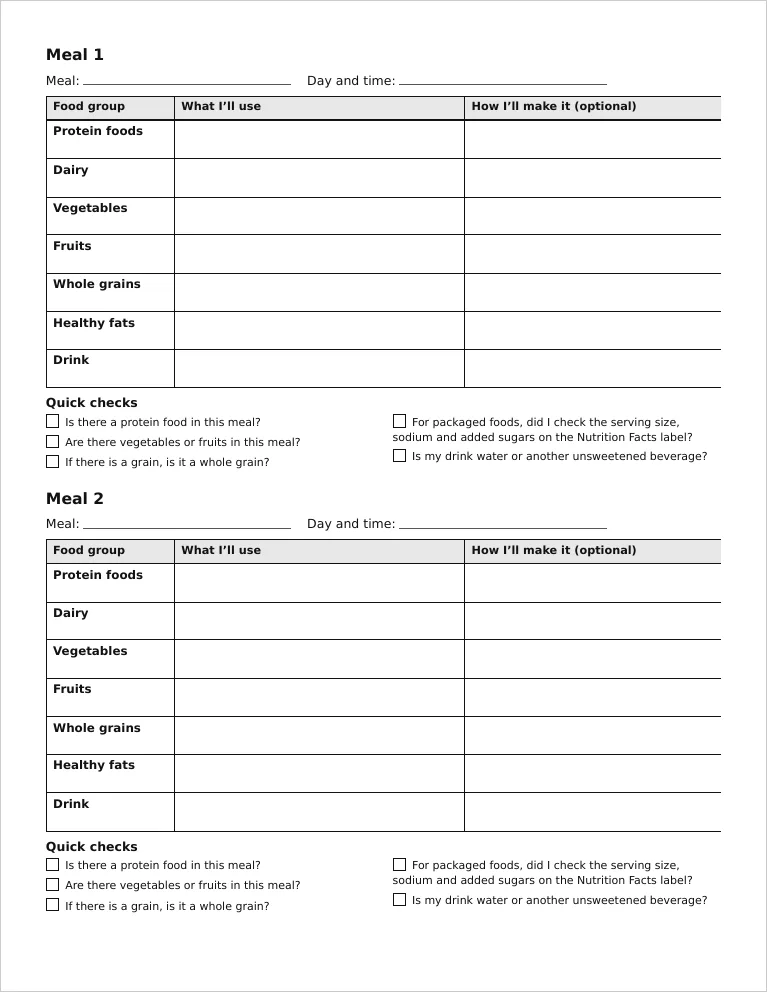
Download the printable meal-assembly worksheet (PDF, 2 pages, 63 KB). It prints on US Letter paper. Page 1 explains the food groups and shows a hypothetical example meal. Page 2 has two blank meal blocks; print it as often as you like.
Accessible version
Each meal block on page 2 has a line for the meal and a line for the day and time, then a table with three columns: Food group; What I’ll use; How I’ll make it (optional). The table has one row for each of the six food groups and one for your drink. To use the worksheet without printing, copy the rows below into a notebook or a document of your own.
| Worksheet row | What counts | Serving-size examples |
|---|---|---|
| Protein foods | Meat, poultry, eggs, seafood, beans, peas, lentils, nuts, seeds and soy | 3 oz cooked meat, poultry or seafood; 1 egg; ½ cup beans, peas or lentils; 1 oz nuts or seeds; 2 tbsp nut or seed butter; 3 oz soy |
| Dairy | Milk, yogurt and cheese, including lactose-free products and fortified dairy alternatives | 1 cup milk; ¾ cup yogurt; 1 oz cheese |
| Vegetables | Vegetables of all types, fresh, frozen or canned, cooked or raw | 1 cup raw or cooked; 2 cups leafy greens |
| Fruits | Fruits of all types, fresh, frozen, canned or dried | 1 cup raw; ½ cup dried |
| Whole grains | Whole-grain foods and products made with whole grains, such as oats, brown rice, barley, quinoa and buckwheat | ½ cup cooked oats, brown rice, barley, quinoa or buckwheat; 1 slice bread; 1 tortilla |
| Healthy fats | Fats in whole foods such as seafood, nuts, seeds, olives and avocados, plus oils such as olive oil used in cooking | 1 tsp olive oil or butter |
| Drink | Water (still or sparkling) or another unsweetened beverage | |
Food groups and serving-size examples follow the Daily Servings guide [3], and the drink row follows the guidelines’ advice on hydration. [2] Serving-size examples show what one serving looks like; they are not an amount to eat at a meal.
Under each table are five quick checks, each with a box to tick:
- Is there a protein food in this meal?
- Are there vegetables or fruits in this meal?
- If there is a grain, is it a whole grain?
- For packaged foods, did I check the serving size, sodium and added sugars on the Nutrition Facts label?
- Is my drink water or another unsweetened beverage?
| Food group | What I’ll use | How I’ll make it (optional) |
|---|---|---|
| Protein foods | Salmon fillet | Baked with lemon and dill |
| Dairy | Plain yogurt | Stirred with garlic as a sauce |
| Vegetables | Green beans and carrots | Roasted |
| Fruits | Sliced peaches | Fresh, after the meal |
| Whole grains | Brown rice | Cooked in water |
| Healthy fats | Olive oil | Tossed with the vegetables before roasting |
| Drink | Sparkling water | With a slice of lime |
How to use the worksheet
- Start with the protein food. The 2025–2030 guidelines put protein foods at every meal, from animal sources such as eggs, poultry, seafood and red meat and from plant sources such as beans, peas, lentils, nuts, seeds and soy. [2]
- Add vegetables or fruits. The guidelines frame vegetables and fruits across the day, and say frozen, dried or canned options with no or very limited added sugars can also be good choices. [2] A meal does not need every row filled.
- Pick a whole grain if the meal has a grain. The guidelines suggest fiber-rich whole grains and list white bread, flour tortillas and crackers among the refined carbohydrates to cut back on. [2]
- Use the “How I’ll make it” column for cooking methods. The guidelines suggest baked, broiled, roasted, stir-fried or grilled methods in place of deep frying. [2]
- Write down the drink. The guidelines suggest water, still or sparkling, and unsweetened beverages, and suggest avoiding sugar-sweetened drinks such as sodas, fruit drinks and energy drinks. [2]
- Leave amounts to your own needs. The guidelines tie their serving goals to calorie levels and note that calorie needs depend on age, sex, height, weight and physical activity; the Daily Servings guide adds that smaller portions may suit people with lower calorie needs, such as some older adults. [2] [3] That is why the worksheet has no amount column.
Checking labels on packaged foods
The fourth quick check is for anything that comes in a package. On the Nutrition Facts label, start with the serving size and the number of servings in the package. The serving size reflects the amount people typically eat or drink, not a recommendation of how much to eat. [6] FDA describes 5% Daily Value or less of a nutrient per serving as low and 20% or more as high, and suggests choosing foods lower in %DV for saturated fat, sodium and added sugars more often. [6]
The 2025–2030 guidelines add that added sugars can appear in an ingredient list under many names, including words that contain “sugar” or “syrup” or end in “-ose”. [2] They also say people ages 14 and older should consume less than 2,300 mg of sodium per day. [2] Our food label reading worksheet practices reading serving size and these label lines step by step.
For fresh foods without a label, USDA FoodData Central is USDA’s source of food composition data, including data for commodity and minimally processed foods. [7] These are reference values for a food in general, not for the item on your plate.
MyPlate materials for children and families
If you are looking for classroom or family MyPlate sheets, USDA Team Nutrition made MyPlate handouts for those settings. MyPlate at Home, for example, is a booklet for parents of school-age children that goes with classroom lessons and repeats messages such as “Make half your plate fruits and vegetables” and “Make half your grains whole grains”. [5] Its page says anyone may download the materials and make copies. [5] Older MyPlate handouts reflect the guidance of their time, so the table above shows where the 2025–2030 edition differs.
What this worksheet can and cannot do
- It is a planning aid, not a meal plan. It helps you see which food groups a meal includes. It does not tell you how much to eat or which foods suit your health.
- It is not a nutrient count. Ticking the boxes does not tell you the calories, sodium or other nutrients in a meal.
- It does not replace prescribed advice. If your health care team has given you a meal plan, theirs comes first. The guidelines themselves say people with a chronic condition should talk with their health care professional about adapting them. [2]
- It has no official status. It is an original Cardio Guardian sheet based on public federal guidance, not a USDA or HHS form.
Where to go next
To see what you actually eat over a week before planning, or to practice reading labels, browse the printable tools in Nutrition and practical resources.
Common questions
Is MyPlate still the federal food icon?
No. MyPlate was the visual icon for the Dietary Guidelines for Americans from 2011 to 2026, and the 2025–2030 edition was published in 2026 with a new visual icon. [1]
What are the food groups now?
The 2025–2030 guidelines name protein foods, dairy, vegetables, fruits, healthy fats and whole grains. [2] MyPlate used fruits, vegetables, grains, dairy or fortified soy alternatives, and protein foods. [4]
Does every meal need every food group?
No. The guidelines put protein foods at every meal and vegetables and fruits throughout the day, so the other groups can be spread across your meals. [2] Leave a row blank when it does not fit the meal.
Can I use the worksheet if I eat vegetarian or vegan?
Yes. The protein row can hold plant foods; the guidelines list beans, peas, lentils, nuts, seeds, tofu and tempeh among protein-rich options for vegetarians and vegans, and suggest paying attention to possible nutrient gaps. [2] The dairy row can hold a fortified dairy alternative or stay blank. [3]
Does this page collect what I write?
No. The worksheet is a PDF that you print and fill in by hand, and this page has no form.
Use the meal-assembly worksheet
Sources and limitations
- DietaryGuidelines.gov (USDA and HHS): Dietary Guidance Development in the United States, a timeline. No date shown on the page. A history of federal dietary guidance editions and icons.
- U.S. Department of Health and Human Services and U.S. Department of Agriculture: Dietary Guidelines for Americans, 2025–2030. January 2026. Population-level federal guidance, not individual advice.
- HHS and USDA: Dietary Guidelines for Americans, 2025–2030, Daily Servings by Calorie Level. Companion guide to the 2025–2030 edition. Only food-group descriptions and serving-size examples are used on this page.
- USDA and HHS: Dietary Guidelines for Americans, 2020–2025. December 2020. The previous edition, cited for its MyPlate section; superseded by the 2025–2030 edition.
- USDA Team Nutrition: MyPlate at Home. Handout dated September 2012 (FNS-447); page updated May 1, 2025. Written for parents of school-age children.
- U.S. Food and Drug Administration: How to Understand and Use the Nutrition Facts Label. Content current as of March 5, 2024. Consumer guidance on the label; not individual dietary advice.
- U.S. Department of Agriculture, Agricultural Research Service: FoodData Central. Home page describing the data types. Values are reference data, not measurements of a specific item.
These statements have not been evaluated by the Food and Drug Administration. This product is not intended to diagnose, treat, cure or prevent any disease.
Not Medical AdviceThe information on this site is for educational purposes only and is not medical advice. Talk with a qualified healthcare practitioner before making changes to your health routine.