Printable 7-Day Food Diary (Free PDF and Accessible Version)
A free printable 7 day food diary PDF for writing down meals, drinks, amounts and context for one week. No calorie counting; accessible version included.
A printable 7-day food diary is a set of pages for writing down everything you eat and drink for one week, as you go. For each entry you note the time, the food or drink, about how much, and the context, such as where you were, what else you were doing and how you felt. MedlinePlus suggests keeping a food journal for one week to learn about your eating habits, then looking back over it for patterns. [1] The free PDF below has one page for each day, a page for looking back over the week, and an accessible version on this page. It has no calorie column and does not ask for any health information.
This page is general education for adults, not individual nutrition advice. The diary does not set a calorie or nutrient target. If you follow a diet prescribed by your health care team, use the instructions they gave you. If writing down what you eat leaves you worried or preoccupied with food, stop and talk with a health care professional.
Print the seven-day food diary
What each column asks for
| Column | What to write | Why it is there |
|---|---|---|
| Time | When you started eating or drinking, such as 7:30 a.m. | A record kept in real time relies on measurements or estimates of amounts rather than on memory, and times show your meal and snack patterns. [2] |
| Meal, snack or drink | What you would call it: breakfast, lunch, dinner, snack or just a drink. | Names of eating occasions help show meal and snack patterns across the week. [2] |
| Food or drink | Each item on its own line or separated by commas, with how it was made and the brand if you know it. Include water, coffee, tea and other drinks. | A food record covers all foods and beverages, and details such as brand name and preparation method make entries clearer. [2] |
| How much | Your best estimate in cups, spoons, pieces or slices, or the number of package servings. | Amounts in a food record can be estimated or measured. A Nutrition Facts label gives its serving size in household measures, and that serving size is not a recommendation. [2] [4] [5] |
| Where, and what else I was doing | For example at home, at work or in the car, and whether you were watching TV, working or talking with someone. | Location and activities during meals show which foods come from home and which from elsewhere. MedlinePlus suggests noting what else you were doing. [1] [2] |
| How I felt (optional) | A word or two, such as hungry, stressed, tired or bored. | MedlinePlus suggests noting how you were feeling, such as hungry, stressed, tired or bored. [1] |
The seven-day food diary
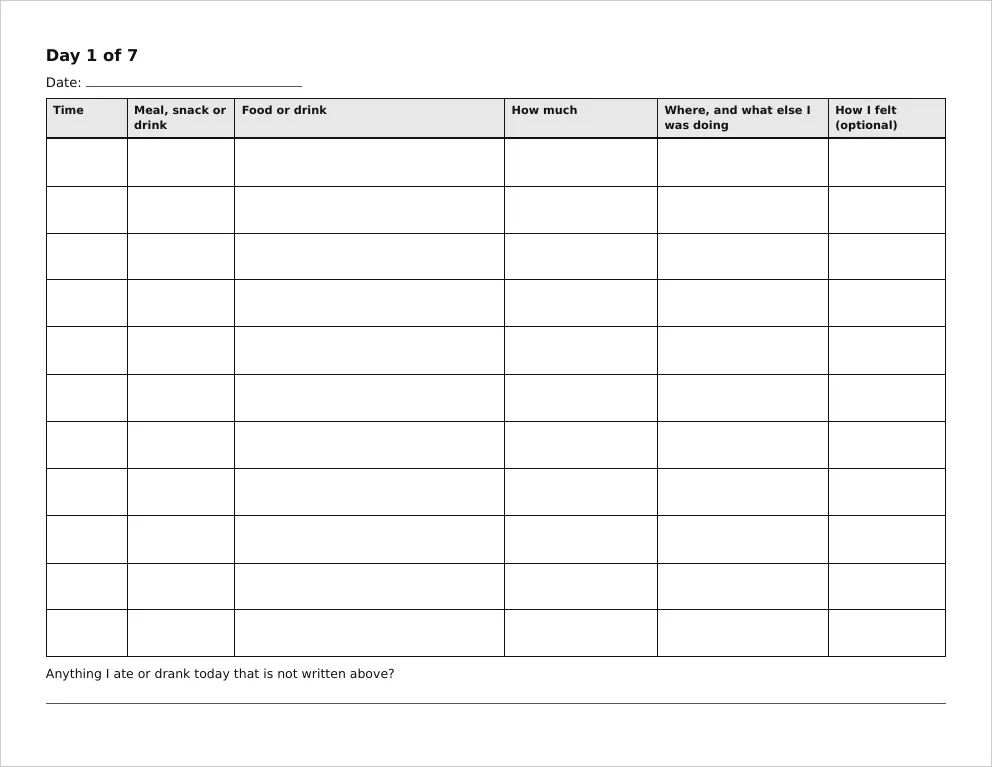
Download the printable seven-day food diary (PDF, 9 pages, 80 KB). It prints on US Letter paper in landscape. Page 1 explains the columns with example entries, pages 2 to 8 are Day 1 to Day 7, and page 9 is for looking back over the week.
Accessible version
Each of the seven day pages has a day number and a date line, a table with the six columns described above and 11 blank rows, and this prompt at the bottom: Anything I ate or drank today that is not written above? To keep the diary without printing, copy the six column headings into a notebook or a document of your own.
| Time | Meal, snack or drink | Food or drink | How much | Where, and what else I was doing | How I felt (optional) |
|---|---|---|---|---|---|
| 7:30 a.m. | Breakfast | Oatmeal cooked with water, topped with raisins; coffee with milk | About 1 cup oatmeal, 2 tablespoons raisins, 1 mug coffee | Kitchen table, reading the news | Hungry |
| 10:15 a.m. | Drink | Water | 1 refillable bottle | At my desk | Thirsty |
| 3:00 p.m. | Snack | Whole-wheat crackers from the office kitchen (label serving: 5 crackers) | 10 crackers (2 servings) | At work, between meetings | Bored, tired |
Looking back over the week
Page 9 of the PDF has these questions, with space to write:
- At what times did I usually eat and drink? Were some days very different from the others?
- What did I drink each day, including water, coffee, tea, milk, juice and soda?
- How many meals or snacks did I eat away from home?
- What was I usually doing while I ate, such as watching TV, working or driving?
- Did the same feelings or situations come up again and again before I ate, such as stress, boredom or tiredness?
- Which habits from this week do I want to keep?
- If I want to change something, which one, two or three things will I focus on first?
How to fill it in
- Write as you go. Food records are usually filled in during the day, as foods and drinks are eaten, rather than from memory later. Expect it to take at least 15 minutes a day. [2]
- Include everything you eat and drink. A food record is meant to cover all foods and beverages, so count small snacks, tastes while cooking and drinks between meals. [2]
- Estimate amounts in a way that works for you. Portions can be estimated using pictures or other visual aids, or measured with a scale or measuring cups and spoons. [2] For a packaged food, compare what you had with the serving size on the label, which is given in units such as cups, pieces or slices followed by grams. Ask yourself whether you had half a serving, one serving or more. [4] [5]
- Remember that a package can hold more than one serving. The label serving size reflects the amount people typically eat or drink. It is not a recommendation of how much you should eat or drink. [4] [5]
- Use the last line on each day. At the end of the day, add anything you forgot to write down.
Reviewing your week
MedlinePlus suggests reviewing your journal at the end of the week and looking at your eating patterns. Circle anything that comes up again and again, such as eating while watching TV, stress at work or having no plan for dinner after a long day. [1] If you decide to change something, MedlinePlus suggests focusing on no more than 2 or 3 goals at a time. It also suggests noticing the healthy habits you already have and not judging yourself too harshly. [1]
The context columns are what make these patterns visible. When the times, places and activities around meals are written down, a food record can show meal and snack patterns, foods eaten at home and away from home, and activities during meals. [2]
What a food diary can and cannot tell you
- Writing things down can change what you eat. People sometimes eat differently when they know they are recording, for example choosing simpler foods that are easier to write down. A week recorded that way may not reflect what you usually eat. [3] When the goal is to support changes you have chosen, NCI notes that this effect of recording can be a helpful one. [3]
- Later days may be less complete. The quality of food records can decline as more days are recorded. [2] Short entries written at the time help.
- One week is a snapshot. What people eat varies from day to day, and a single set of recorded days cannot account for all of that variation. [2]
- A diary is not a nutrient count. Nutrient amounts can only be worked out from a food record by matching each entry to a food composition database. [2] This diary is meant for noticing patterns, not for counting.
- A diary cannot diagnose anything. It is a record of what you ate and drank, not a test. Questions about your health or a prescribed diet belong with your health care team.
Looking up foods you recorded
If you want to know more about a packaged food in your diary, its Nutrition Facts label lists the amounts in one serving. [4] Our food label reading worksheet practices reading serving size and a few key lines of the label.
For foods without a label, USDA FoodData Central is USDA’s comprehensive source of food composition data. Its Foundation Foods data cover commodity and minimally processed foods, its SR Legacy data are historical and had their final update in 2018, and its Branded Foods data are label data from commercial food brands. [6] These are reference values for a food in general, not for the item you ate.
Where to go next
If you have questions about what you recorded, you can bring the diary to your doctor or another health care professional. More printable tools are listed in Nutrition and practical resources.
Common questions
How long should I keep a food diary?
MedlinePlus suggests keeping a food journal for one week, then reviewing it for patterns. [1] This PDF has a page for each of those seven days.
Do I need to weigh or measure my food?
No. In food records, portions are either estimated, for example with pictures or other visual aids, or measured with scales or measuring cups. [2] Estimates in cups, spoons, pieces or slices are fine for this diary.
Will keeping a diary change what I eat?
It may. People sometimes change what they eat because they know they are recording it, so the week may not reflect your usual habits. [3]
Should I write down calories?
This diary has no calorie column, and you do not need to count anything. If your health care team has asked you to track something specific, use the method they gave you.
Does this page collect what I write?
No. The diary is a PDF that you print and fill in by hand, and this page has no form. What you write stays with you, and you decide whether to share it with anyone.
Print the seven-day food diary
Sources and limitations
- MedlinePlus Medical Encyclopedia: Eating habits and behaviors. Review date April 1, 2025. Patient guidance on changing eating habits, including keeping a one-week food journal.
- National Cancer Institute, Dietary Assessment Primer: Food Record at a Glance. Last updated December 29, 2025. Written for researchers measuring diet in groups of people, not for individual self-tracking.
- National Cancer Institute, Dietary Assessment Primer: Learn More about Reactivity. Last updated December 29, 2025. Research guidance on how recording affects reported diet.
- U.S. Food and Drug Administration: How to Understand and Use the Nutrition Facts Label. Content current as of March 5, 2024. Consumer guidance on the label; not individual dietary advice.
- U.S. Food and Drug Administration: Serving Size on the Nutrition Facts Label. Content current as of March 5, 2024. Explains how serving sizes are set; does not say how much any person should eat.
- U.S. Department of Agriculture, Agricultural Research Service: FoodData Central. Home page describing the data types and how often each is updated. Values are reference data, not measurements of a specific item.
These statements have not been evaluated by the Food and Drug Administration. This product is not intended to diagnose, treat, cure or prevent any disease.
Not Medical AdviceThe information on this site is for educational purposes only and is not medical advice. Talk with a qualified healthcare practitioner before making changes to your health routine.