Digestive and Circulatory System Working Together: A Labeled Diagram
Digestive and circulatory system working together: a labeled food-to-bloodstream diagram of absorption, the portal vein, lymph and gut arteries.
The digestive and circulatory systems work together by passing nutrients from one to the other: the digestive system breaks food into parts small enough to absorb, the small intestine takes in most of them, and the circulatory system carries them to the rest of the body to store or use. [1] Simple sugars, amino acids, glycerol and some vitamins and salts enter tiny blood vessels (capillaries) in the lining of the small intestine and travel through the portal vein to the liver first. Fats and the fat-soluble vitamins enter small lymph vessels called lacteals and reach the bloodstream later, through large veins at the base of the neck. [1] [2] In the other direction, the heart pumps oxygen-rich blood through the aorta and its gut arteries to the digestive organs themselves. [3] [4] Absorbing a nutrient describes where it goes, not whether it benefits your heart.
Safety comes first. NHLBI says to call 911 any time you think you might be having a heart attack, even if you are not sure. Its list of heart attack symptoms includes chest pain or discomfort; pain or discomfort in the arms, back, shoulders, neck, jaw or above the belly button; shortness of breath; nausea and vomiting; and light-headedness. [5] MedlinePlus says to get medical help right away or call 911 if you are vomiting blood or have blood in your stool (especially bright red, maroon or dark, tarry black), have sudden, sharp abdominal pain, have a belly that is rigid and hard to the touch, are unable to pass stool (especially if you are also vomiting), or have difficulty breathing. [6] For bleeding, MedlinePlus says to call 911 or go to the nearest emergency room for black, tarry stools, vomit that looks like coffee grounds, or feeling lightheaded or dizzy from the bleeding. [7] MedlinePlus also says a sudden blockage of blood flow to the intestines by a clot is an emergency, and to contact your health care provider for frequent abdominal pain after you eat. [8] This page explains normal physiology. It cannot tell you whether a symptom comes from your heart or your digestive system, and it is not a reason to start, stop or change any medicine.
This page explains normal adult physiology in general terms, simplified for a diagram. Anatomy varies from person to person. [4] [9] It is not a guide to anyone’s symptoms, test results or diet.
How the two systems connect
Digestion is a team effort. NIDDK describes nerves, hormones, bacteria, blood and the digestive organs working together to digest what you eat and drink. Your body needs the nutrients in food for energy, growth and cell repair, and the digestive system breaks them into parts small enough to absorb. [1]
The circulatory system is a network of blood vessels, including arteries, veins and capillaries, with the heart at its center. It carries blood to and from all areas of the body, and that blood carries the oxygen and nutrients organs need to work. [10] The two systems meet in the wall of the small intestine, the main site of absorption, where finger-like villi increase the surface area for taking in nutrients. [2]
The connection runs both ways. The digestive organs need blood too: the arteries that supply the intestines come directly off the aorta, the main artery from the heart, and blood brings oxygen to the intestines as it does to every other part of the body. [8]
Labeled diagram: from food to the bloodstream
Follow the numbers. The left column shows the digestive organs, the middle column the two routes absorbed nutrients take into the blood, and the right column the heart, lungs and arteries. Labels, numbers and line styles carry the meaning, so you do not need to tell colors apart to read it.
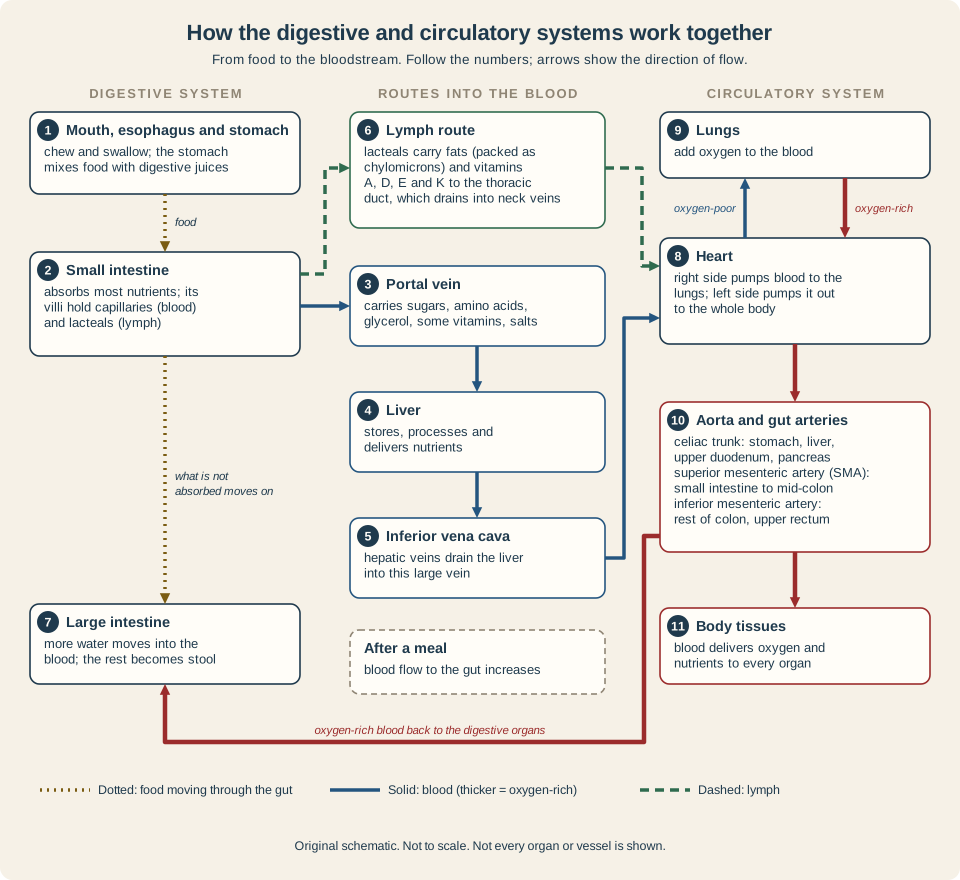
Full text equivalent
- Mouth, esophagus and stomach: you chew and swallow, and the stomach muscles mix food and liquid with digestive juices, including acid and enzymes that break food down. [1]
- Small intestine: absorbs most of the nutrients in food. Its villi increase the surface area for absorption, and each villus holds blood capillaries and a lymph vessel called a lacteal. [1] [2]
- Portal vein: blood from the villus capillaries carries simple sugars, amino acids, glycerol and some vitamins and salts to the liver. Veins from the stomach, intestines, spleen, pancreas and gallbladder all drain into the portal vein. [1] [2] [9]
- Liver: stores, processes and delivers nutrients to the rest of the body when needed. [1]
- Inferior vena cava: hepatic veins drain the liver into the inferior vena cava, one of the two large veins that return oxygen-poor blood to the heart. [9] [3]
- Lymph route: fats are packed into particles called chylomicrons and enter the lacteals, along with vitamins A, D, E and K. The lymph collects into the thoracic duct, which in most people drains into large veins at the base of the neck: the internal jugular vein, the subclavian vein or the point where they meet. [2]
- Large intestine: more water moves from the gut into the bloodstream, and waste, including parts of food still too large to absorb, becomes stool. [1]
- Heart: the right side pumps oxygen-poor blood to the lungs; the left side pumps oxygen-rich blood to the whole body. [3]
- Lungs: add oxygen to the blood, which returns to the heart through the pulmonary veins. [3]
- Aorta and gut arteries: blood leaves the heart through the aorta. Three of its branches supply the digestive organs: the celiac trunk (stomach, liver and the upper parts of the duodenum and pancreas), the superior mesenteric artery (the small intestine to about two-thirds of the way along the transverse colon) and the inferior mesenteric artery (the rest of the colon and the upper rectum). [3] [4]
- Body tissues: blood carries oxygen and nutrients to the organs that need them. [10]
- After a meal: blood flow to the stomach and intestines increases. [11]
Which route each nutrient takes
The table follows the nutrients the sources name from the inside of the small intestine to the next stop.
| Nutrient | How it leaves the intestine | Where it goes next |
|---|---|---|
| Simple sugars, amino acids, glycerol, some vitamins and salts | Into the blood capillaries of the villi. [1] [2] | Through the portal vein to the liver, which stores, processes and passes them on. [1] [2] |
| Fats | Rebuilt inside intestinal cells into triglycerides, packed into chylomicrons and passed into the lacteals (lymph). [2] | Through lymph vessels to the thoracic duct, which empties into large veins at the base of the neck. [2] |
| Vitamins A, D, E and K (fat-soluble) | Carried inside chylomicrons into the lymph. [2] | Into the general circulation; they are stored mainly in fat tissue. [2] |
| Water | Absorbed through the walls of the small intestine, and more in the large intestine. [1] | Into the bloodstream. [1] |
The sources describe the fat route with different levels of detail. NIDDK says the lymph system absorbs fatty acids and vitamins. [1] StatPearls adds that some fatty acids leave intestinal cells into the portal system, while fats rebuilt into chylomicrons go into the lacteals. [2]
Why blood from the gut reaches the liver first
Veins from the stomach, small and large intestines, spleen, pancreas and gallbladder join to form the portal vein, a single inflow into the liver. [9] This blood carries nutrients and other substances absorbed from food, and it makes up about 75% of the liver’s blood supply; the rest comes from the hepatic artery. [9] Liver cells further process, store and distribute nutrients, which then reach the rest of the body through the hepatic veins and the inferior vena cava. [2] [9]
How the heart sends blood back to the gut
Oxygen-poor blood, including blood from the liver, returns to the heart through the superior and inferior vena cava. The right side of the heart pumps it to the lungs, which add oxygen. The left side then pumps oxygen-rich blood out through the aorta to the whole body. [3]
Three unpaired branches of the abdominal aorta, the celiac trunk, the superior mesenteric artery and the inferior mesenteric artery, supply the gastrointestinal tract, liver, pancreas, spleen and gallbladder. [4]
Blood flow to the gut is not fixed. It is well established that blood flow to the stomach and intestines increases after a meal, a response called postprandial hyperemia. The increase in oxygen use and blood flow after a meal has been shown in people, and it is thought to meet the extra oxygen needs of digestion and absorption. [11] Much of the detailed evidence comes from animal studies, and the mechanisms are not yet clearly defined. [11]
Absorbing a nutrient is not the same as a heart benefit
This diagram shows where nutrients go after they are absorbed. It does not show what any nutrient, food or supplement does for your heart or blood vessels, and reaching the bloodstream is not evidence of a benefit.
- More is not always better. Vitamins A, D, E and K are stored mainly in fat tissue, and chronic excessive intake may cause toxicity. [2]
- Supplements are not approved before sale. The FDA does not have the authority to approve dietary supplements for safety and effectiveness, or their labeling, before they are sold. Some supplements can interact with medicines or interfere with lab tests, and the FDA advises against using a supplement in place of a prescription medicine or a varied diet. [12]
- Absorption can go wrong. Some conditions disrupt digestion, absorption or the way nutrients are carried on through the lymph and portal systems. Sorting that out is a job for a clinician, not a diagram. [2]
To see what a packaged food actually lists, the Nutrition Facts label shows key nutrients, and every amount on it refers to one serving. [13] The food label reading worksheet walks through what a label does and does not tell you.
When digestive and heart symptoms overlap
Because the two systems share space and blood supply, their warning signs can look alike. NHLBI lists pain or discomfort above the belly button, nausea and vomiting among heart attack symptoms, and says it is possible to have mild symptoms or none at all and still be having a heart attack. [5]
- Blocked gut arteries. Mesenteric artery ischemia is a narrowing or blockage of the arteries that supply the intestines. MedlinePlus lists abdominal pain after eating among the symptoms of gradual narrowing, and sudden severe abdominal pain or bloating among the symptoms of a sudden blockage by a clot, which it calls an emergency. [8]
- Bleeding in the digestive tract. MedlinePlus says black, tarry stools, vomiting blood or material that looks like coffee grounds, and feeling lightheaded or dizzy from bleeding all call for 911 or the nearest emergency room. [7]
No home check can tell a heart problem from a digestive one. If you think you might be having a heart attack, NHLBI says to call 911 even if you are not sure. [5] Do not start, stop or change a medicine because of anything on this page; ask the clinician who prescribed it.
Limits of this page
The diagram is a simplified schematic: it leaves out many vessels and organs, and arterial branching varies between people. [4] The NIDDK overview used here is older than the other sources, and the review of blood flow after meals draws largely on animal research. [1] [11] Each source’s date and limitations are listed below.
For more on how blood moves through the body, browse Heart and circulation or practice naming the heart’s chambers and vessels with the circulatory system worksheets.
Common questions
How do the digestive and circulatory systems work together?
The digestive system breaks food into nutrients small enough to absorb, the small intestine absorbs most of them, and the circulatory system passes them on to other parts of the body to store or use. [1] In return, arteries branching from the aorta bring oxygen-rich blood to the digestive organs. [4] [8]
Where do nutrients go after the small intestine absorbs them?
Most travel in the blood through the portal vein to the liver, which stores, processes and delivers them to the rest of the body. Blood leaving the liver reaches the general circulation through the inferior vena cava. [1] [2] [9]
Why do fats take a different route?
Inside intestinal cells, fats are packed into chylomicrons, which enter the lacteals instead of the blood capillaries. The lymph flows to the thoracic duct, which drains into large veins at the base of the neck. [2]
Does blood flow to the gut change after eating?
Yes. Blood flow to the stomach and intestines increases after meals, and this has been shown in people. Much of the detailed research is in animals, and the mechanisms are not yet clearly defined. [11]
Does absorbing a nutrient mean it helps your heart?
No. Absorption describes the route a nutrient takes, not its effect on the heart. Some nutrients cause harm in excess: chronic excessive intake of fat-soluble vitamins may cause toxicity. [2] The FDA does not approve dietary supplements for safety and effectiveness before they are sold. [12]
Can a heart problem feel like a stomach problem?
It can. NHLBI lists pain or discomfort above the belly button, nausea and vomiting among heart attack symptoms. It says to call 911 any time you think you might be having a heart attack, even if you are not sure. [5]
Safety comes first. NHLBI says to call 911 any time you think you might be having a heart attack, even if you are not sure. Its list of heart attack symptoms includes chest pain or discomfort; pain or discomfort in the arms, back, shoulders, neck, jaw or above the belly button; shortness of breath; nausea and vomiting; and light-headedness. [5] MedlinePlus says to get medical help right away or call 911 if you are vomiting blood or have blood in your stool (especially bright red, maroon or dark, tarry black), have sudden, sharp abdominal pain, have a belly that is rigid and hard to the touch, are unable to pass stool (especially if you are also vomiting), or have difficulty breathing. [6] For bleeding, MedlinePlus says to call 911 or go to the nearest emergency room for black, tarry stools, vomit that looks like coffee grounds, or feeling lightheaded or dizzy from the bleeding. [7] MedlinePlus also says a sudden blockage of blood flow to the intestines by a clot is an emergency, and to contact your health care provider for frequent abdominal pain after you eat. [8] This page explains normal physiology. It cannot tell you whether a symptom comes from your heart or your digestive system, and it is not a reason to start, stop or change any medicine.
Sources and limitations
- NIDDK: Your Digestive System & How It Works. Last reviewed December 2017. A consumer overview last reviewed in December 2017, older than the other sources here; it describes digestion in general terms.
- StatPearls: Physiology, Nutrient Absorption (Basile EJ, Shukla K, Launico MV, Sheer AJ). Updated December 1, 2025. A physiology review written for health professionals; it describes typical absorption, not any one person, and does not address heart outcomes.
- NHLBI: How Blood Flows through the Heart. Updated June 25, 2025. General anatomy education for the public.
- StatPearls: Anatomy, Abdomen and Pelvis: Arteries (Lung K, Lui F). Updated July 24, 2023. An anatomy reference for health professionals; branching patterns vary between people.
- NHLBI: Heart Attack Symptoms. Updated March 24, 2022. Public education on heart attack warning signs; symptoms vary from person to person.
- MedlinePlus Medical Encyclopedia: Abdominal pain. Review date January 13, 2026. General adult information; its lists of warning signs are examples, not complete lists.
- MedlinePlus Medical Encyclopedia: Gastrointestinal bleeding. Review date January 24, 2025. General adult information; not a diagnostic tool.
- MedlinePlus Medical Encyclopedia: Mesenteric artery ischemia. Review date January 13, 2026. General adult information about one condition; symptom lists are examples, not a diagnostic checklist.
- StatPearls: Anatomy, Abdomen and Pelvis, Portal Venous System (Hepatic Portal System) (Harkins JM, Ahmad B). Updated August 8, 2023. An anatomy reference for health professionals; percentages are approximate and anatomy varies between people.
- NHLBI: How the Heart Works. Updated March 24, 2022. General anatomy education for the public.
- Kvietys PR. The Gastrointestinal Circulation, Chapter 5: Postprandial Hyperemia. Morgan & Claypool Life Sciences. Published 2010. A 2010 research monograph; much of the evidence it reviews comes from animal studies, and it states that the mechanisms are not clearly defined.
- FDA: FDA 101: Dietary Supplements. Content current as of June 2, 2022. U.S. consumer guidance on how supplements are regulated; it does not evaluate any product.
- FDA: How to Understand and Use the Nutrition Facts Label. Content current as of March 5, 2024. U.S. consumer guidance on reading the label; the label lists amounts per serving and does not describe absorption.
These statements have not been evaluated by the Food and Drug Administration. This product is not intended to diagnose, treat, cure or prevent any disease.
Not Medical AdviceThe information on this site is for educational purposes only and is not medical advice. Talk with a qualified healthcare practitioner before making changes to your health routine.