Circulatory System Worksheets: Free Printable With Answer Key
A free circulatory system worksheet for adults: 15 questions on the heart, blood vessels and blood flow, with a checked answer key and printable PDF.
Circulatory system worksheets are practice sheets that test what you know about the heart, the blood vessels and the path blood takes through the body. The free worksheet on this page is written for adults. It has 15 questions in three parts: match six terms to their jobs, put the route blood takes through the heart in order, and answer short questions about vessels, blood and blood clots. It includes an answer key, with each answer checked against the cited NIH page, and a printable PDF. In short, the heart pumps blood through arteries, capillaries and veins, carrying oxygen and nutrients to the organs and carrying carbon dioxide to the lungs to be breathed out. [1]
Safety first: call 9-1-1 for chest pain or other possible heart attack symptoms, even if you are not sure. [10] Call 9-1-1 now for unexplained trouble breathing, chest pain or discomfort that worsens with a deep breath, coughing up blood, or fainting, which can be signs of a blood clot in the lungs. Do not wait for a callback. [11] [12] For a newly swollen, tender, painful leg without those emergency symptoms, get prompt medical care: call a healthcare provider right away. [9] [11] This worksheet tests knowledge. It cannot tell you whether you have a clot or any heart or blood vessel problem.
The worksheet describes typical adult anatomy in general terms. It is not a health-risk score, and your result says nothing about your own heart or blood vessels.
Arteries, capillaries and veins at a glance
Several worksheet questions ask how the three kinds of blood vessel differ. The table sums up what the National Cancer Institute’s anatomy training module says about each one. [5]
| Question | Arteries | Capillaries | Veins |
|---|---|---|---|
| Which way blood flows | Away from the heart. [5] | From the smallest arteries to the smallest veins; capillaries connect the two. [5] | Toward the heart. [5] |
| Oxygen in the blood | Systemic arteries carry oxygen-rich blood to the body. Pulmonary arteries carry low-oxygen blood to the lungs. [5] | Oxygen and nutrients pass to the tissues; carbon dioxide and waste are picked up. [6] | Systemic veins carry blood with reduced oxygen back to the heart. Pulmonary veins carry oxygen-rich blood from the lungs. [5] |
| Main job | Deliver blood to the tissues through branches that get smaller and smaller, ending in arterioles. [5] | Exchange materials between the blood and tissue cells. [5] | Return blood to the heart, starting from small venules that join into larger veins. [5] |
| Walls | Three layers; the muscular middle layer is usually the thickest and changes the vessel’s width. [5] | The smallest and most numerous blood vessels. [5] | The same three layers, with less muscle, so the walls are thinner; this is linked to the lower pressure of blood in veins. [5] |
| Valves | None mentioned in the source. | None mentioned in the source. | Medium and large veins have valves that help keep blood flowing toward the heart. [5] |
| Share of blood at any moment | About 10 percent in the systemic arteries. [5] | About 5 percent in the systemic capillaries, with another 10 percent in the lungs. [5] | Almost 70 percent. [5] |
One detail often catches people out: “artery” means a vessel that carries blood away from the heart, not a vessel that carries oxygen-rich blood. The pulmonary arteries carry low-oxygen blood. [5] Question 8 tests this.
The circulatory system worksheet
Answer the questions from memory, then check yourself against the answer key below. The page asks you to type nothing and saves nothing.
Download the printable worksheet and answer key (PDF, 4 pages, 102 KB). The PDF has writing lines, a word bank and an ordering table, with the answer key and answer diagram on separate pages.
Part 1: Match the word to its job
Write one word from the word bank next to each description. Each word is used once.
Word bank: artery, atrium, capillary, valve, vein, ventricle
- A blood vessel that carries blood away from the heart.
- A blood vessel that carries blood toward the heart.
- The smallest blood vessel, where materials pass between the blood and the body’s tissue cells.
- One of the two upper chambers of the heart, which receive blood coming in from the body and lungs.
- One of the two lower chambers of the heart, which pump blood out to the lungs and the rest of the body.
- A set of flaps that opens to let blood through and closes to stop it from flowing backward.
Part 2: Follow the blood through the heart
Oxygen-poor blood from the body enters the heart through two large veins, the superior and inferior vena cava. Number steps A to H from 1 to 8 in the order the blood reaches them.
- Put steps A to H in order, starting with the first place the blood goes after the vena cava.
| Step | Place |
|---|---|
| A | Left ventricle |
| B | Pulmonary artery |
| C | Right atrium |
| D | Aorta, then out to the body |
| E | Lungs, where blood picks up oxygen |
| F | Left atrium |
| G | Pulmonary veins |
| H | Right ventricle |
Part 3: Short questions
Answer in a word or a sentence.
- True or false: every artery carries oxygen-rich blood. Explain your answer.
- Which ventricle pumps blood through the lungs, and which pumps blood to the rest of the body?
- What do the valves in medium and large veins do, and where are they especially important?
- Name the liquid part of blood and the three solid parts. Which solid part helps blood clot after a cut?
- Which arteries carry blood to the heart muscle itself, and where do they branch from?
- A heartbeat sounds like “lub-DUB.” What makes the first sound, the “lub”?
- What is venous thromboembolism (VTE), and what are its two types?
- Can this worksheet, or your score on it, tell you whether you have a blood clot or a heart problem?
Answer key
Each answer cites the page it was checked against. Count your correct answers if you like: the number shows what you remembered about anatomy, not anything about your health.
- Artery. Arteries carry blood away from the heart. [5]
- Vein. Veins carry blood toward the heart. [5]
- Capillary. Capillaries are the smallest and most numerous blood vessels, and their main job is the exchange of materials between the blood and tissue cells. [5]
- Atrium. The two upper chambers are the atria. Blood flows from the body and lungs into the atria, then into the ventricles. [2]
- Ventricle. The ventricles pump blood out of the heart to the lungs and other parts of the body. [2]
- Valve. Heart valves keep blood moving in the right direction and stop it from flowing backward. Their flaps are called cusps or leaflets. [3]
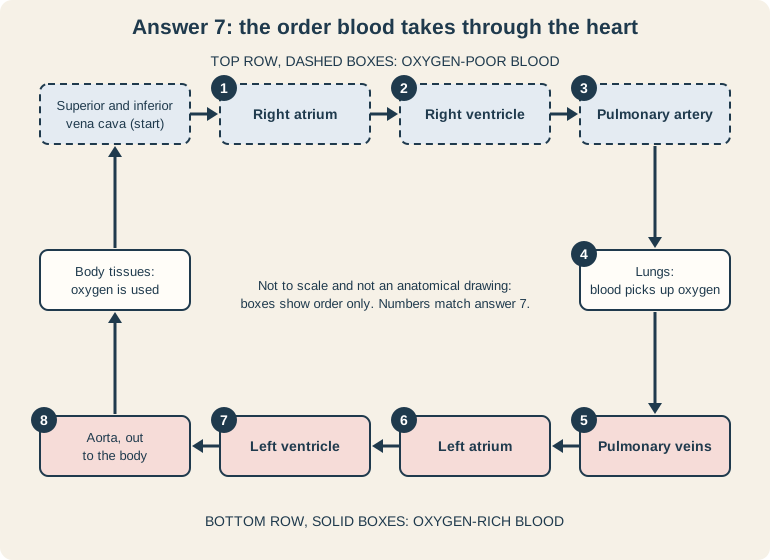
- C, H, B, E, G, F, A, D: right atrium, right ventricle, pulmonary artery, lungs, pulmonary veins, left atrium, left ventricle, then the aorta and out to the body. [3]
- False. The pulmonary arteries carry blood with a low oxygen content from the right ventricle to the lungs. Systemic arteries carry oxygen-rich blood from the left ventricle to the body. [5]
- The right ventricle pumps blood through the lungs (the pulmonary circuit). The left ventricle pumps blood to the rest of the body (the systemic circuit). [6]
- They help keep blood flowing toward the heart. They are especially important in the arms and legs, where they stop blood from flowing back down with the pull of gravity. [5]
- The liquid part is plasma, made of water, salts and protein. The solid parts are red blood cells, white blood cells and platelets. Platelets help blood clot when you have a cut or wound. [7]
- The coronary arteries. They branch off from the aorta, so the heart gets oxygen-rich blood as well as the rest of the body. [3]
- The valves between the atria and the ventricles closing after the atria have pumped blood into the ventricles. [4]
- VTE is a condition in which a blood clot forms in a vein. Its two types are deep vein thrombosis (DVT), a clot in a deep vein, usually in the lower leg, thigh or pelvis, and pulmonary embolism (PE), when a clot breaks loose and travels through the bloodstream to the lungs. [8]
- No. It tests knowledge, not health. VTE symptoms are not the same for everyone, and VTE sometimes has no obvious signs. A healthcare provider uses tests to find out whether someone has the condition. [9] [8]
Answer diagram for question 7
How the answers were checked
Every answer was compared, sentence by sentence, with the wording of the page it cites: NHLBI’s How the Heart Works pages, NHLBI’s venous thromboembolism pages, the National Cancer Institute’s SEER anatomy training modules and MedlinePlus. [1] [5] [7] [8] The worksheet keeps to points those pages state directly. Where they simplify, so does the worksheet: answer 7 follows the main route through the heart and lungs and leaves out branches such as the coronary circulation, which question 12 covers separately. [3]
What this worksheet does not cover
- Circulation before birth. Most fetal circulation is like an adult’s, but there are notable differences because the lungs, digestive tract and kidneys are not working before birth. [6] The worksheet describes the adult pattern only.
- Hearts that developed differently. Congenital heart disease is when the heart does not develop in the typical way, so the textbook route may not match every person’s heart. [2]
- Numbers about your body. The worksheet has no pulse, blood pressure or other health numbers to compare yourself against, and it is not a symptom checklist.
- Blood clot symptoms. Question 14 asks what VTE is, not whether you have it. DVT and pulmonary embolism cause different symptoms, symptoms vary between people, and VTE sometimes causes none until serious complications develop. [9]
To keep learning, browse the Heart and circulation guides, including types of vein and how vein valves work. If you like practice sheets, try the food label reading worksheet.
Common questions
Who is this circulatory system worksheet for?
Adults who want to review how the heart and blood vessels work, such as students, caregivers or anyone curious about anatomy. The sources it is checked against are general education pages written for adult readers or anatomy trainees. [1] [5]
Why is blood shown as blue and red in diagrams?
The colors stand for oxygen-poor and oxygen-rich blood. NHLBI’s heart diagram, for example, shows oxygen-poor blood in blue-purple and oxygen-rich blood in red. [2] The answer diagram here uses dashed and solid outlines instead, so the meaning does not depend on color.
What is the difference between the pulmonary and systemic circuits?
The pulmonary circuit carries blood from the right ventricle through the lungs and back to the left atrium. The systemic circuit carries blood from the left ventricle to the tissues of the whole body and back to the right atrium. [5] [6]
What do the heart valves do?
The heart has four valves: tricuspid, mitral, pulmonary and aortic. They open and shut in time with the pumping of the heart’s chambers and stop blood from flowing backward. [3]
Does a high score mean my heart is healthy?
No. The score shows what you know about anatomy. It cannot show anything about your heart or blood vessels. Heart attacks can even happen with mild symptoms or none at all. [10] Ask a healthcare provider about any concern.
Safety first: call 9-1-1 for chest pain or other possible heart attack symptoms, even if you are not sure. [10] Call 9-1-1 now for unexplained trouble breathing, chest pain or discomfort that worsens with a deep breath, coughing up blood, or fainting; do not wait for a callback. [11] [12] For a newly swollen, tender, painful leg without those emergency symptoms, call a healthcare provider right away. Do not use this worksheet to rule out a clot. [9] [11]
Sources and limitations
- NHLBI: How the Heart Works, The Heart. Updated March 24, 2022. General education about the heart and circulatory system for adults.
- NHLBI: What the Heart Looks Like. Updated March 24, 2022. General anatomy education; describes the typical heart.
- NHLBI: How Blood Flows through the Heart. Updated June 25, 2025. General anatomy education; simplifies the route for teaching.
- NHLBI: How the Heart Beats. Updated June 25, 2025. General education; the worksheet uses only its description of heart sounds.
- National Cancer Institute SEER Training Modules: Classification and Structure of Blood Vessels. No page date shown. An anatomy training module for cancer registry staff; NCI states it is not medical advice. Blood-volume shares are approximate textbook figures.
- National Cancer Institute SEER Training Modules: Circulatory Pathways. No page date shown. Anatomy training module; describes adult circulation and notes how fetal circulation differs.
- MedlinePlus: Blood. Updated May 11, 2023. Consumer summary from the National Library of Medicine; general information, not a guide to blood test results.
- NHLBI: What Is Venous Thromboembolism? Updated September 19, 2022. General clinical education; risk factors describe groups, not a personal assessment.
- NHLBI: Venous Thromboembolism Symptoms. Updated September 19, 2022. Symptoms vary and are not a home rule-out checklist.
- NHLBI: Heart Attack Symptoms. Updated March 24, 2022. Symptoms differ between people; call 9-1-1 even if unsure.
- Centers for Disease Control and Prevention: About Venous Thromboembolism (Blood Clots). Reviewed March 5, 2025. Lists common signs of DVT and of pulmonary embolism and when to seek care; signs vary and some people have none.
- MedlinePlus Medical Encyclopedia: When to use the emergency room - adult. Review date July 15, 2026. Lists examples of emergency signs; it is not a complete list.
These statements have not been evaluated by the Food and Drug Administration. This product is not intended to diagnose, treat, cure or prevent any disease.
Not Medical AdviceThe information on this site is for educational purposes only and is not medical advice. Talk with a qualified healthcare practitioner before making changes to your health routine.