Purpose of Valves in Veins: How One-Way Vein Valves Work
The purpose of valves in veins is to keep blood flowing toward the heart. See a labeled diagram and how vein valves differ from heart valves.
The purpose of valves in veins is to keep blood moving one way: back toward the heart. Many veins, especially in the legs, have small one-way valves inside them. When nearby muscles squeeze a vein, the valve flaps open and blood moves up. When the muscles relax, blood that starts to slip back fills the flaps and pushes them shut, so it does not flow backward. [1] [2] [3] These vein valves are separate from the four valves inside the heart. [5]
Safety first: call 9-1-1 for chest pain or other possible heart attack symptoms, even if you are not sure, and for any bleeding from a varicose vein. [9] [1] Call a healthcare provider right away for a swollen, tender leg that is painful to the touch, or for shortness of breath or pain when breathing, which can be signs of a blood clot. [7] [8] This page explains normal valve function. It cannot tell you whether you have a clot or a valve problem.
This page describes typical adult anatomy in general terms. It is not a guide to an individual’s veins, symptoms or test results.
Vein valves and heart valves compared
Both kinds of valve keep blood moving in one direction. They sit in different places, are moved by different forces, and are checked in different ways. [4] [5]
| Question | Valves in veins | Heart valves |
|---|---|---|
| Where they are | Inside many veins, including deep, superficial and perforating (connecting) veins; especially important in the legs. [2] | Inside the heart: the tricuspid, pulmonary, mitral and aortic valves. [5] |
| What they do | Keep blood flowing toward the heart and stop it from flowing back down. [1] | Keep blood moving in the right direction through the heart and stop it from flowing backward. [5] |
| What moves blood past them | Squeezing muscles, especially the calf muscles when you walk, helped by breathing. [2] [3] | The pumping of the heart’s chambers; the valves open and shut with each heartbeat. [5] [6] |
| The moving parts | Flaps that close when blood starts to flow back. [1] [2] | Flaps called cusps or leaflets. [5] |
| When they do not work well | Backward flow is called reflux. Weak or damaged valves are linked with varicose veins and chronic venous insufficiency. [1] [4] | A valve can leak (regurgitation), be too narrow (stenosis) or lack a proper opening (atresia). [6] |
| How a clinician checks | A physical exam and often a duplex ultrasound of blood flow in the leg veins. [1] [4] | Asking about symptoms, listening to the heart and imaging tests. [6] |
Labeled diagram: how a vein valve opens and closes
The two panels show the same leg vein a moment apart. Follow the red arrows for blood movement. The drawing shows direction, not exact valve shape, size or spacing. [1] [2] [3]
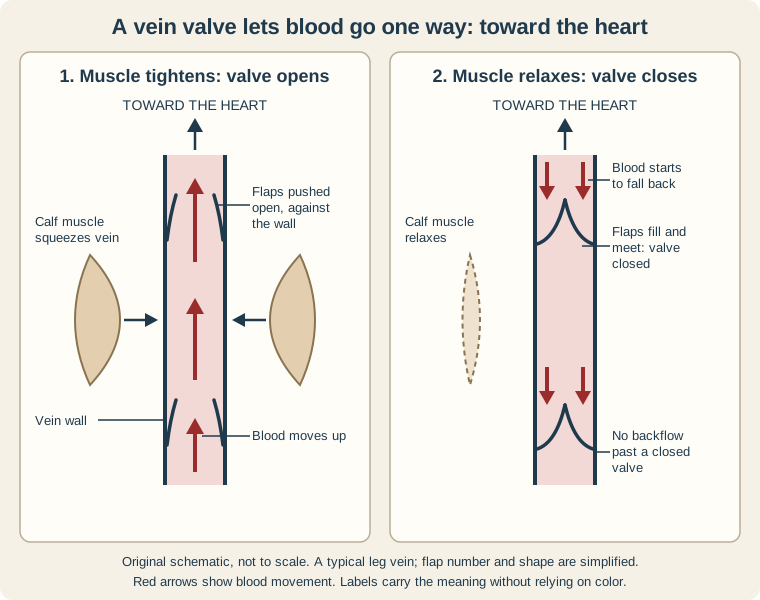
Full text equivalent
- Panel 1, muscle tightens: the calf muscle beside the vein tightens and squeezes it. [2] [3]
- The squeeze pushes blood upward. The blood presses the valve flaps open, flat against the vein wall, and passes through toward the heart. [1] [3]
- Panel 2, muscle relaxes: the squeeze stops, and gravity pulls some blood back down the leg. [2]
- The falling blood fills the pocket-shaped flaps. The flaps swing toward the middle, meet and close. [1]
- With the valve closed, blood does not flow backward past it. The next muscle squeeze moves it up again. [1] [3]
Where vein valves matter most
Blood in the legs has to travel upward against gravity, so valves are especially important there. Deep veins sit among the muscles, superficial veins lie just under the skin, and short perforating veins connect the two. All three contain valves. [2]
- Muscle squeeze. Cleveland Clinic calls the calf muscles a “second heart”: each step squeezes the deep veins of the foot and calf and pushes blood upward. [2] A 2023 review focused on older adults describes the same pump, with the valves directing flow toward the heart. [3]
- Breathing. As the lungs expand and the diaphragm moves, they help draw blood in the veins toward the heart. [2]
- Connecting veins. Valves in perforating veins close when the calf muscles tighten, so blood does not flow back from the deep veins into the superficial ones. [2] [3]
- Moving versus standing still. The same review notes that walking lowers pressure in the leg veins compared with standing. [3] NHLBI notes that walking makes the lower-leg muscles contract, which helps blood return toward the heart, and advises asking your provider what level of activity is right for you. [1]
When vein valves do not close well
NHLBI explains that weak or damaged valves or vein walls can let blood pool and even flow backward (reflux). Over time the veins may enlarge and twist into varicose veins. NHLBI lists older age, pregnancy, overweight and obesity, long periods of sitting or standing, inactivity and a family history as factors linked with varicose veins. [1]
MedlinePlus describes chronic venous insufficiency as a long-term condition in which leg veins have trouble sending blood back to the heart. It is most often due to valves that no longer close properly, and it can also follow a past blood clot in the leg. [4] In a narrative review of chronic venous insufficiency in older adults, advanced age was the most common risk factor, linked partly to changes in vein walls and weaker calf muscles. A narrative review summarizes earlier studies; it is not a new trial and does not predict any one person’s risk. [3]
What appearance cannot tell you
You cannot see a valve from the outside, and the look of your legs cannot rule a problem in or out. A clinician uses a physical exam and history and may order a duplex ultrasound to check blood flow. [1] [4] NHLBI also notes that a blood clot in a vein sometimes causes no obvious signs. [12] Bring any new or changing leg symptoms to a healthcare professional rather than matching them to a drawing.
Vein valves and supplement claims
Be wary of any product that says it repairs, rebuilds or restores vein valves. Under federal law, FDA does not approve dietary supplements before they are sold and generally does not approve their claims. [10] A supplement label that describes an effect on the body must also state that the product is not intended to “diagnose, treat, cure or prevent any disease,” because only a drug can legally make that kind of claim. [11]
NHLBI describes vein procedures that close off or remove the vein causing the problem so that other veins take over, rather than mending its valves. [1] FDA advises talking with your doctor, pharmacist or other health care professional before using a supplement, partly because some interact with medicines. [10]
For more on how blood moves through the body, browse Heart and circulation or compare superficial, deep and pulmonary veins in our guide to types of vein. For practice reading what a label does and does not say, try the food label reading worksheet.
Common questions
Are valves in veins the same as heart valves?
No. The heart has four valves that open and shut with each heartbeat. Vein valves sit inside the veins themselves, mostly matter in the legs, and rely on muscle squeeze rather than the heart’s pumping. [2] [5]
Do arteries have valves like veins do?
Cleveland Clinic describes one-way valves as a difference between veins and arteries: veins sometimes contain them. Veins also have thinner, less muscular walls because the pressure inside them is lower. [2]
Why do leg veins depend on valves so much?
Blood in the legs has to move upward against gravity. Valves keep each squeeze of the calf muscles from being undone when the muscles relax. [2] [3]
Can I tell if my vein valves are damaged by looking at my legs?
No. Bulging veins, swelling or skin changes can have several causes, and a clot can occur without obvious signs. A clinician decides, using an exam and often a duplex ultrasound. [1] [4] [12]
Can a supplement repair vein valves?
Be cautious of repair claims. FDA does not approve supplements before they are sold or generally approve their claims, and supplement labels may not claim to treat disease. Ask a healthcare professional about vein concerns and before taking a supplement, since some interact with medicines. [10] [11]
Safety first: call 9-1-1 for chest pain or other possible heart attack symptoms, or for bleeding from a varicose vein. [9] [1] Call a healthcare provider right away for a swollen, tender, painful leg, shortness of breath or pain when breathing. Do not use this diagram to rule out a clot. [7] [8]
Sources and limitations
- NHLBI: Varicose Veins. Updated September 26, 2023. General patient education about leg veins; risk factors are for groups, not a personal assessment.
- Cleveland Clinic: Veins. Updated June 19, 2022. General anatomy overview for adults; not a study.
- Mayrovitz HN, Aoki KC, Colon J. Chronic Venous Insufficiency With Emphasis on the Geriatric Population. Cureus. 2023;15(6):e40687. Published June 20, 2023. Narrative review focused on older adults; summarizes earlier research rather than reporting a new trial.
- MedlinePlus Medical Encyclopedia: Venous insufficiency. Review date June 4, 2026. General adult information; not a diagnostic tool.
- NHLBI: How Blood Flows through the Heart. Updated June 25, 2025. General anatomy education.
- NHLBI: What Are Heart Valve Diseases? Updated March 24, 2022. General overview of heart valve conditions.
- NHLBI: Venous Thromboembolism Symptoms. Updated September 19, 2022. Symptoms vary and are not a home rule-out checklist.
- NHLBI: Pulmonary Embolism. Updated September 19, 2022. General clinical education.
- NHLBI: Heart Attack Symptoms. Updated March 24, 2022. Symptoms differ between people; call 9-1-1 even if unsure.
- FDA: Questions and Answers on Dietary Supplements. Describes US regulation; it does not evaluate any specific product.
- FDA: Structure/Function Claims. Describes US labeling rules for supplements; it does not evaluate any specific product.
- NHLBI: What Is Venous Thromboembolism? Updated September 19, 2022. General clinical education.
These statements have not been evaluated by the Food and Drug Administration. This product is not intended to diagnose, treat, cure or prevent any disease.
Not Medical AdviceThe information on this site is for educational purposes only and is not medical advice. Talk with a qualified healthcare practitioner before making changes to your health routine.